
Thomas Cromwell's Book of Hours
by Dr Nicolas Bell (e2015), Librarian
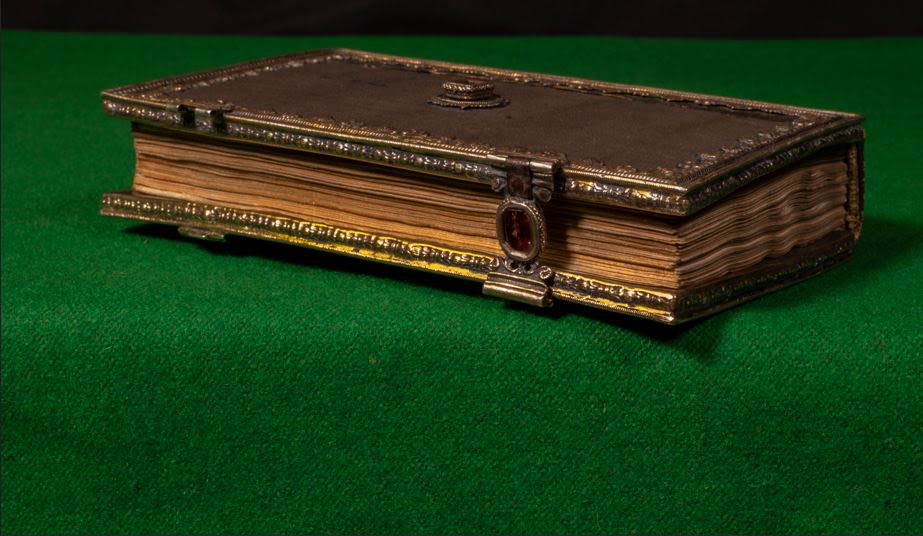

The book depicted by Hans Holbein the Younger in his portrait of Thomas Cromwell, Chief Minister to King Henry VIII, was identified in 2023 as a specially bound Book of Hours held in the Wren Library at Trinity. Printed in Paris by Germain Hardouyn in 1527 or 28, this book was presented to Trinity in 1660 by Anne Sadleir, who was married to the grandson of Cromwell’s secretary, Ralph Sadleir.
The Holbein portrait dates from 1532-33 and is thought to commemorate Cromwell’s appointment as Master of the Royal Jewel House. It seems likely that the book was positioned so prominently in the painting because of its grand binding with jewels mounted in silver gilt. The identification was made following a request to loan this book to an exhibition at Hever Castle, the home of the Boleyn family. The castle possesses a copy of the same edition of this book which was owned by Anne Boleyn, and a third copy of this edition, now in the Morgan Library & Museum in New York, was owned by Catherine of Aragon. Both of these other copies have been rebound at a later date, so it is impossible to be sure of their outward appearance in the sixteenth century, but it is notable that three copies of the same edition had such prominent owners.

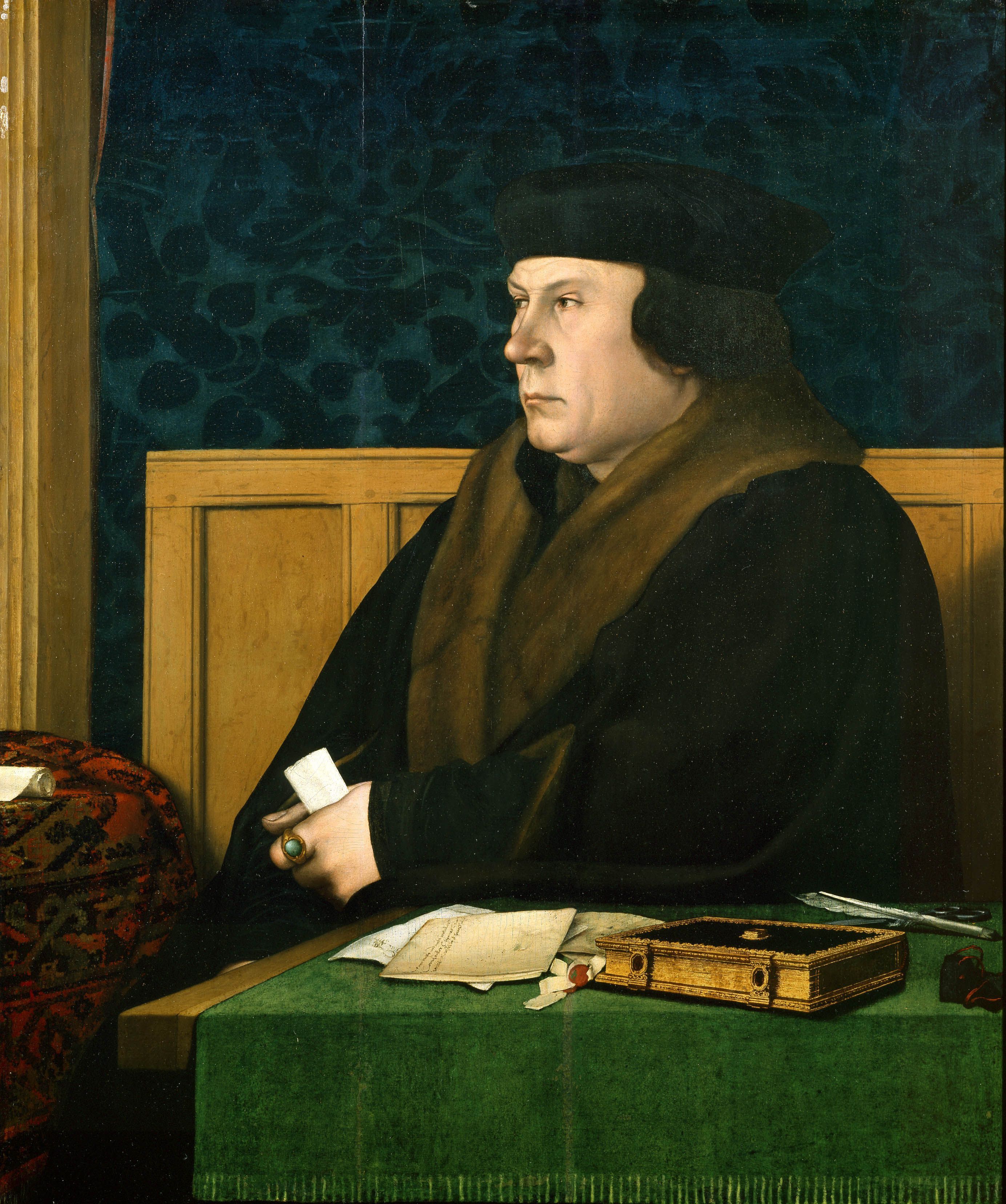
Thomas Cromwell by Hans Holbein the Younger. © The Frick Collection. Photo: Michael Bodycomb.
Thomas Cromwell by Hans Holbein the Younger. © The Frick Collection. Photo: Michael Bodycomb.
The discovery was first noticed by Hever Castle’s curator Alison Palmer. Further research at Hever by Kate McCaffrey and Dr Owen Emmerson has shown that the silver borders are the work of Pierre Mangot, goldsmith to King Francis I of France. The binding consists of wooden boards covered with black or dark blue velvet and surmounted with silver gilt borders which are fixed to each board with a single nail. Hallmarks on the silver borders prove that the binding was manufactured in 1530. The book does not include a precise date of printing, but the prefatory material includes a list of the dates of Easter for the following 14 years, which starts with the date of Easter in 1528.

![Almanac showing the date of Easter in 1528 ([M]DXXVII) as 12 April.](./assets/QuxtLY70IN/almanac-easter-454x205.jpg)
Almanac showing the date of Easter in 1528 ([M]DXXVII) as 12 April.
Almanac showing the date of Easter in 1528 ([M]DXXVII) as 12 April.
This suggests that the book was probably printed between Easter 1527 and Easter 1528. It was then illuminated by hand in Hardouyn’s workshop, before being bound in 1530 and shipped to England sometime before 1532-33, when the portrait was painted. It seems likely that Thomas Cromwell gave this book to his secretary Ralph Sadleir, along with the Holbein portrait. Sadleir’s son Thomas was named after Cromwell, who had been his godfather, and Thomas Sadleir’s own son, Ralph, was the second husband of Anne Sadleir, who gave the book to Trinity College, where her father, the famous lawyer Sir Edward Coke, had studied.
The result of this analysis is conclusive evidence that the stones are in fact grossular garnets, another gem frequently used in ornamental metalwork of this period.
There was still a question to be answered about the jewels found on the binding and clasps. When Anne Sadleir presented the book on 10 August 1660, the jewels on the binding were described as jasper stones. This was corrected by a later writer to ‘hyacinthi’, or jacinths, but Pierre Mangot was well known for his use of another semi-precious stone, carnelian. Each of these stones has various symbolic meanings attributed to it in writings of the time, and it remained intriguing to establish the true identity of the stones. In order to prove with certainty what type of gemstones were used in the binding, we took the book to the NanoPhotonics Centre in the Cavendish Laboratory, where PhD student Joanna Symonowicz used Raman spectroscopy to analyse the chemical structure of the stones.

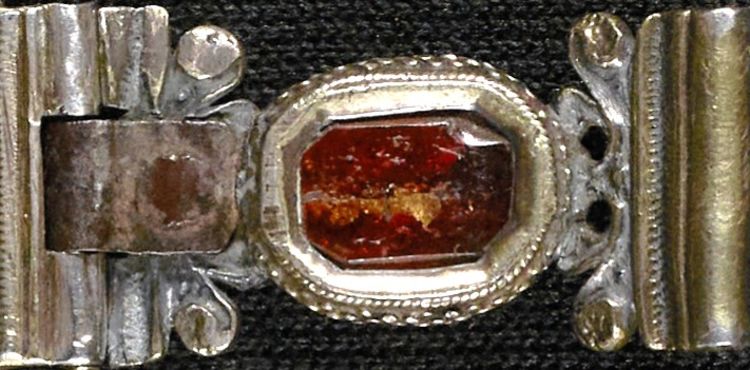
Closeup of the gemstone clasp.
Closeup of the gemstone clasp.
The result of this analysis is conclusive evidence that the stones are in fact grossular garnets, another gem frequently used in ornamental metalwork of this period and with a wide range of possible significance or meaning to its owners.
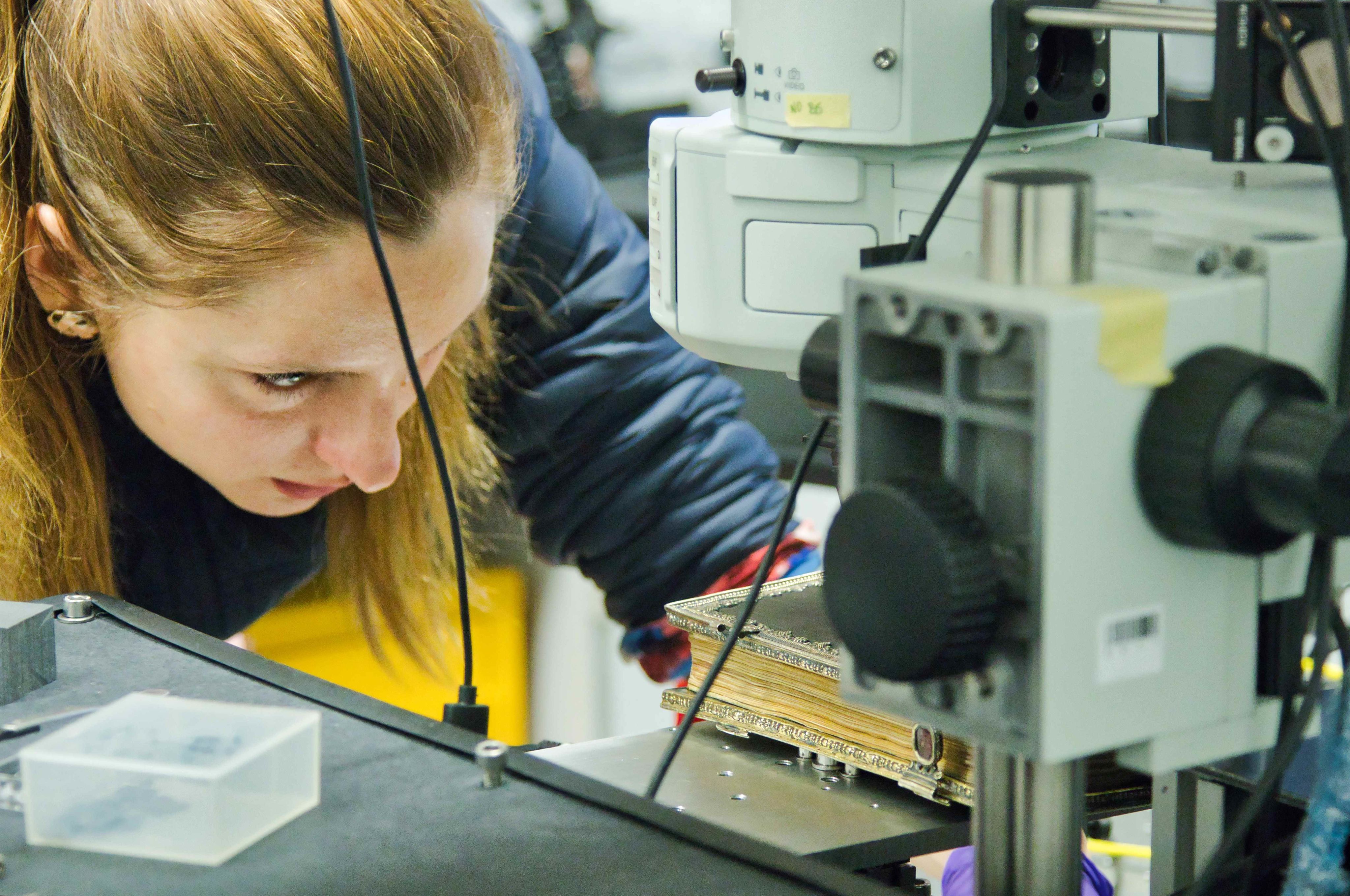
Joanna Symonowicz users lasers to analyse the gemstones. © Xuan Trung Nguyen. With thanks to Dr Giuliana Di Martino, Department of Materials Science and Metallurgy.
Joanna Symonowicz users lasers to analyse the gemstones. © Xuan Trung Nguyen. With thanks to Dr Giuliana Di Martino, Department of Materials Science and Metallurgy.
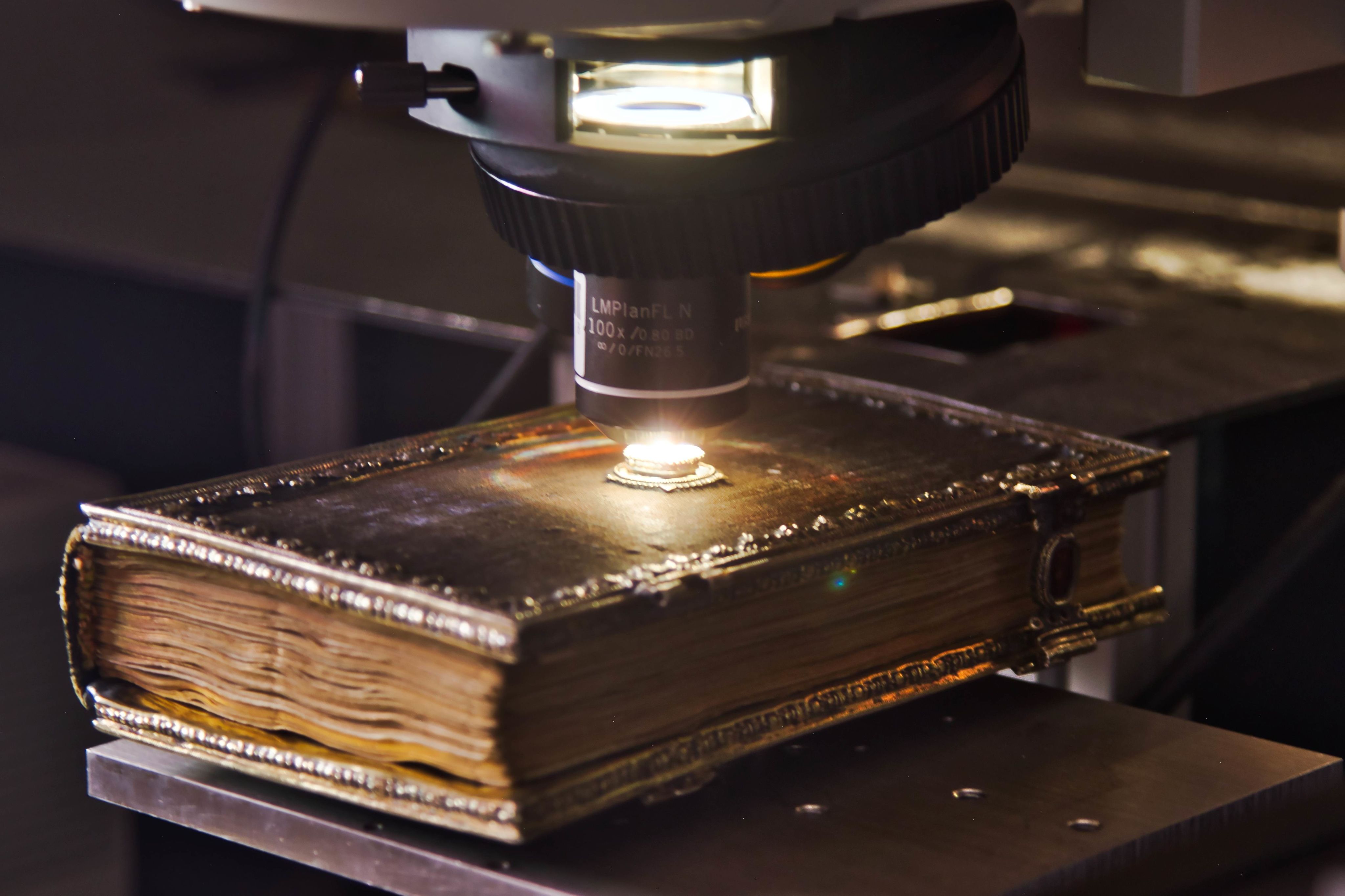
The Book of Hours being analysed.
The Book of Hours being analysed.
Despite this new identification, various questions remain unanswered. Why would Thomas Cromwell have chosen to be portrayed by Holbein with a private devotional book such as this? There are no annotations or other signs that Cromwell actually used the book in prayer, but it is rather extraordinary that, unlike in almost every other liturgical book in England, the calendar of saints in this book has not been amended by the removal of the feast of Thomas Becket, as was required by royal edict of Henry VIII in 1538.

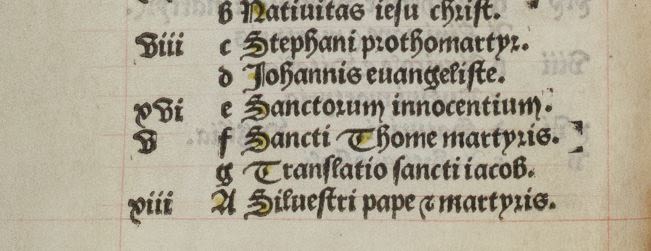
The calendar of saints' feasts includes Thomas of Canterbury, martyred on 29 December 1170 but not erased from this book, despite the royal edict requiring his removal.
The calendar of saints' feasts includes Thomas of Canterbury, martyred on 29 December 1170 but not erased from this book, despite the royal edict requiring his removal.
There are intriguing links between the goldsmith Pierre Mangot and the Boleyn family, both of whom were living in Blois in the 1520s. It is even possible that Holbein may have collaborated with Mangot at some point, and not inconceivable that he may have been involved in the design of the book which he took such care to depict in the portrait. The strong likelihood that Anne Sadleir received this book from her husband also raises questions about the earlier history of the other book she gave to Trinity on the same day, the famous Trinity Apocalypse. Previous accounts of this book have presumed that she came into its possession through her eminent father, Sir Edward Coke, but perhaps a more likely route would trace this valuable manuscript from her husband directly to the court of Henry VIII through his trusted Master of the Jewel House, Thomas Cromwell.
View the book
Thomas Cromwell's Book of Hours is fully digitised and can be viewed online via the Wren Digital Library.
 Built with Shorthand