Editorial, Annual Record 2025
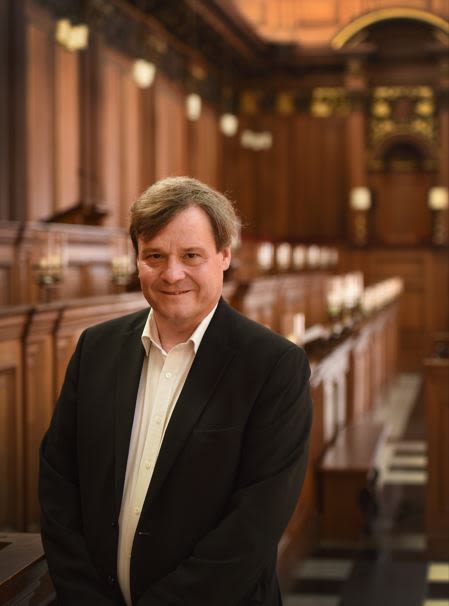
Dr Paul Wingfield (1990)


My editorial last year began with accounts of anniversary celebrations of two Trinity alumni who have long had prominent public profiles: one of the College’s most (in)famous students, the poet Lord Byron (1788–1824), and its illustrious former Director of Music Charles Villiers Stanford (1852–1924). Next year we will commemorate the 400th anniversary of the death of the enormously influential English philosopher and statesman, Francis Bacon (1561–1626), often nicknamed the ‘Father of empiricism’. But in the year 2025 the focus has been on alumni whose achievements have perhaps not hitherto received the attention they deserve.
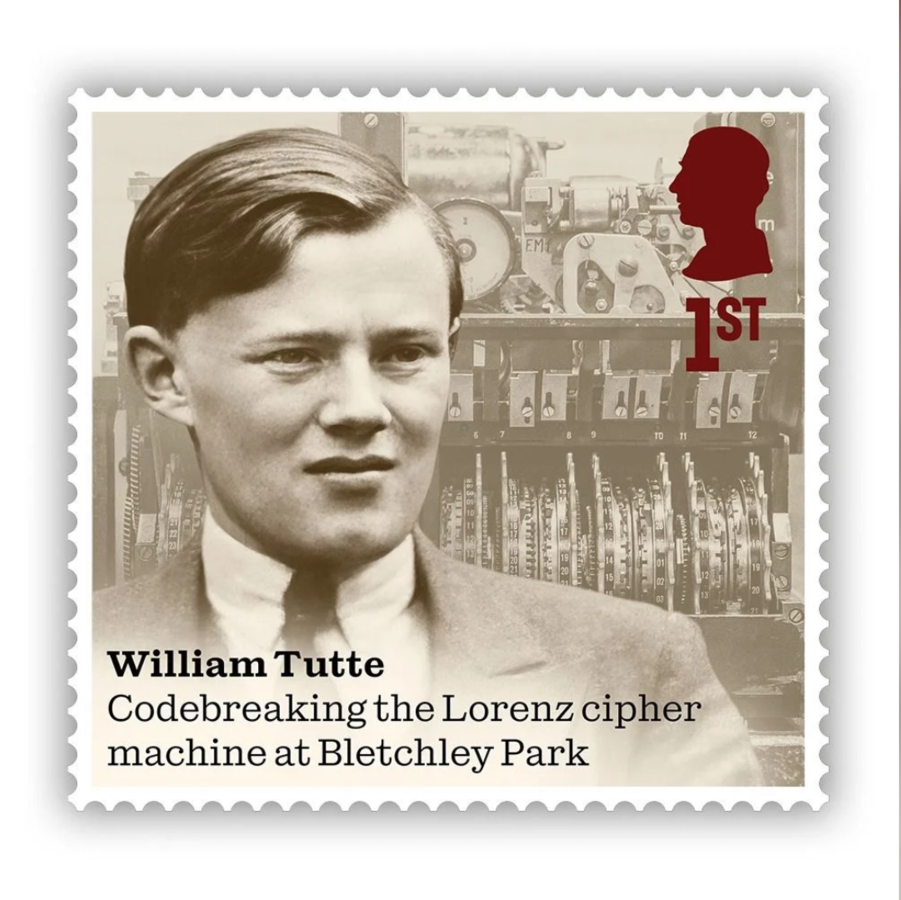
In May 2025, Trinity announced that it will honour William (Bill) Tutte (1917– 2002) with a new work of art, in recognition of his achievements. Tutte was born in Newmarket, schooled in Cheveley village and Cambridge, and won a scholarship to come up to study Natural Sciences at Trinity in 1935. Naturally self-effacing, Tutte came to prominence whilst still a student when he and three others published a solution to the difficult ‘squaring the squares’ problem in a leading mathematics journal. At the outbreak of the Second World War he was recruited by Bletchley Park and was set to work on top secret German High Command messages encrypted by a Lorenz cipher machine. Although expectations were low, Tutte succeeded in deducing and inferring the structure of Lorenz, and his solution was implemented by Colossus, the world’s first programmable electronic computer built by GPO engineer Tommy Flowers. In the words of Professor Imre Leader: ‘The most remarkable thing was not just that Lorenz was more complex than Enigma, but that Tutte deduced how it worked without ever having seen the machine.’ Professor Béla Bollobás adds: ‘I am sure it’s true that his work shortened or even decided the war. The fact is he broke the code of the German High Command – many of the messages were signed ‘Führer’– which had enormous significance.’ Tutte’s career after the War took him to Canada, and he spent most of his working life at the University of Waterloo. Despite the crucial importance of his Wartime activities, Tutte was never honoured by the British Government, belated recognition coming this year when he featured on a commemorative VE Day 80th anniversary first-class stamp. The new work of art for Tutte will at long last pay tribute to an illustrious alumnus whose work has hitherto been somewhat overlooked.

The year 2025 was also the centenary of the matriculation of another Trinity alumnus, Keiichi Kurosawa (1903–82), the eldest son of a wealthy Japanese industrialist who read Moral Sciences in 1925–28. A talented cellist, whilst at Trinity Kurosawa immersed himself in College music and the emerging British Early Music scene spear-headed by Arnold Dolmetsch. After his return to Japan in 1928 Kurosawa founded the Tokyo Madrigal Club (1929) and became a key figure in introducing Western Early Music to Japan in the mid-20th century. In November of this year, Trinity marked the achievements of this to date neglected alumnus with an excellent talk by Jason James OBE, Director General of the Daiwa Anglo-Japanese Foundation, and a concert recreating one Kurosawa put on when an undergraduate in the exact same venue, the Old Combination Room.
This year’s three feature articles focus on aspects of the College’s past, present and future respectively. In 2025, the Trinity First & Third Boat Club celebrated its bicentenary. In a eminently readable article, Luke Barratt gives a fascinating and erudite account of the history of the Trinity boat clubs, from the first hiring of a four-oar named ‘Shannon’ in the spring of 1825 and the formation of Cambridge’s oldest boat club, up to the triumph of Imogen Grant – who first took up an oar at First & Third in 2014 – in the lightweight double sculls in the 2024 Paris Olympics, a century after Third Trinity coxless four seized Olympic gold in the same waters. Trinity Librarian, Dr Nicolas Bell, explains in exquisite detail the history behind and the symbolism of the Master’s recently granted coat of arms, which are now displayed in a magnificent new stained glass window in one of the hitherto blank panes of Hall’s West Oriel window. As Dr Bell observes, ‘this continues a tradition that has been ongoing since the construction of the Hall in 1604, and provides a fitting tribute to the first Dame Grand Cross to be a member of the College’. The third of this year’s features is a most topical jointly-authored article outlining how sustainability is reshaping the College’s future – in all aspects from investment, building and renovation to catering and gardening – and further arguing that this focus on sustainability is a ‘fundamental extension of the College’s centuries-old charitable objective of
“advancing education, learning, religion, and research” ’.

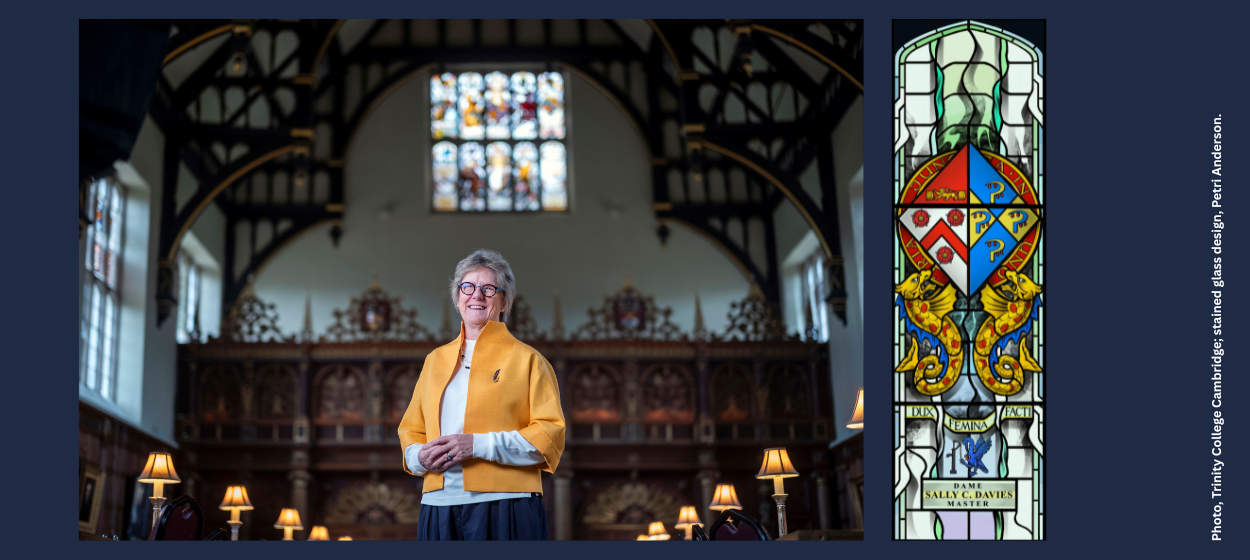
The Master's coat of arms has been incorporated into a striking design for the new stained-glass window in the Hall.
The Master's coat of arms has been incorporated into a striking design for the new stained-glass window in the Hall.
The year 2025 has been a bumper one for alumni Honours. In the New Year Honours, Alex Kendall (2014) was awarded an OBE for services to Artificial Intelligence, our Olympic gold medallist, Imogen Grant (2014), received an MBE for services to Rowing, John Westwell (1982) an MBE for services to Education, and Bee Wilson (1992) an MBE for services to Food Writing and Food Education. In the King’s Birthday Honours, sculptor Antony Gormley (1968) was made Companion of Honour for services to Art and Emily Shuckburgh (1994) was awarded a CBE for services to Climate Science; James Korner (1974) received an OBE for services to Philanthropy and to Charity, and Andrew Makower (1980) for services to Parliament; Jennifer Gold (2005) was awarded an MBE for services to Evidence-based Policy Making, and Laura Silverman (2000) for services to Social Innovation and Education.
Amongst the College’s current Fellows, Professor Judith Driscoll (Materials Science), Professor Jason Miller (Mathematics) and Professor Marta Zlatić (Molecular Biology) were elected Fellows of the Royal Society. Professor Shankar Balasubramanian added to his already glittering array of prizes by winning the Khorana Prize of the Royal Society of Chemistry; and Professor Gary Gibbons was awarded the Dirac Medal, for redefining our understanding of gravity. In addition, our students once again excelled themselves in Tripos examinations, topping the 2025 Tompkins Table by a comfortable margin, with ten of them achieving the highest marks in their Triposes. On the sporting front, there were some noticeable successes: the Mixed Netball team won Cuppers; the Rugby team won the Boot Final, taking its first silverware since the pandemic; and the Pool team won its division and was promoted. There has been a strong drive to increase participation in sporting activities, and altogether there were teams competing in 21 sports, including a newly-formed Padel team.

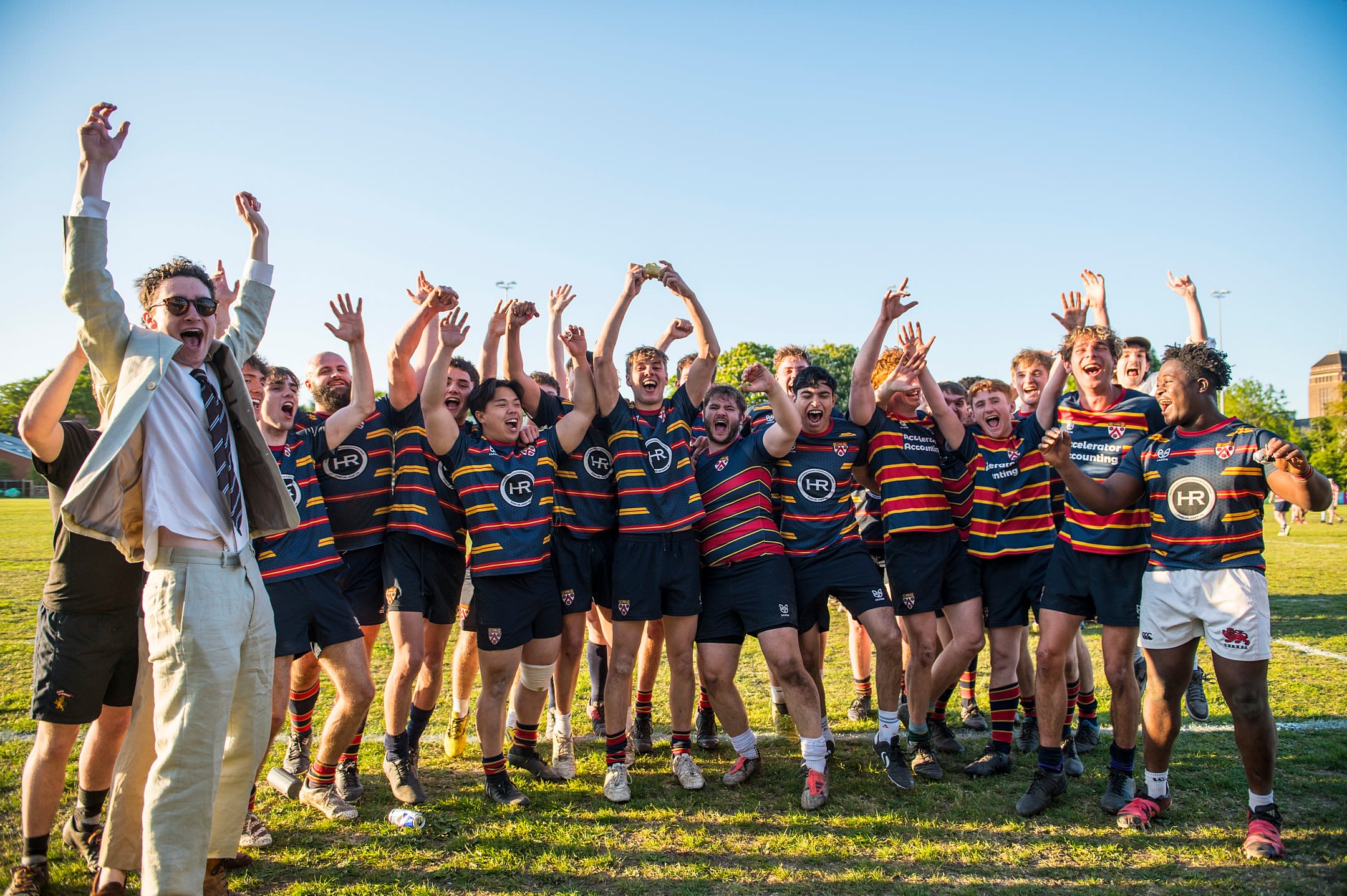
TCRUFC celebrate winning the Rugby Cuppers Boot Final.
TCRUFC celebrate winning the Rugby Cuppers Boot Final.
Each year it is my sad duty to report the loss to the Trinity community of Fellows and distinguished alumni. This year’s Annual Record contains just one obituary. Brian Mitchell was elected a Fellow in 1967 and lectured in the Economics Faculty until his retirement in 1991. He was also a long-time member of the Cambridge University Rugby Union Football Club (CURUFC), and he put in many years of dedicated service as Treasurer of the College’s Field Club. I am immensely grateful to Professor Mark Bailey (a former England Rugby international and Research Fellow of Gonville & Caius at the same time as me) for giving us permission to adapt the tribute he wrote in September for CURUFC. Brian will be much missed.
As I write, Fellows are enjoying the ambience of the newly-refurbished Hall complete with new stained-glass window, and are also weighing up shortlisted proposals for the development of the Brewhouse site, which forms a core part of the Trinity 2046 estate plan to celebrate our 500th anniversary. In this atmosphere of forward momentum, as we look to the College’s next 500 years, I wish you all a peaceful and joyful festive period, and a most rewarding 2026.
Dr Paul Wingfield (1990)

 Built with Shorthand