
A New Window for the Hall
Dr Nicolas Bell (e2015), Librarian


In the New Year’s Honours 2020, the Master was appointed Dame Grand Cross of the Order of the Bath, in recognition of her services to public health and to research. The only previous holder of this honour was the Princess Alice, Duchess of Gloucester. Dame Sally Davies was handed the insignia of her new office at an investiture ceremony in the week before the Covid Pandemic took hold, but has not yet been formally installed in the Lady Chapel at Westminster Abbey. The service of installation requires Knights or Dames to have their coat of arms displayed on their stall in the chapel, with an heraldic banner hanging above. In preparation for this occasion, it was first necessary for Dame Sally to be granted a coat of arms. This in turn led to the College Council agreeing to install a stained glass window in the Hall to continue the longstanding tradition of displaying the heraldic insignia of notable members of the College.

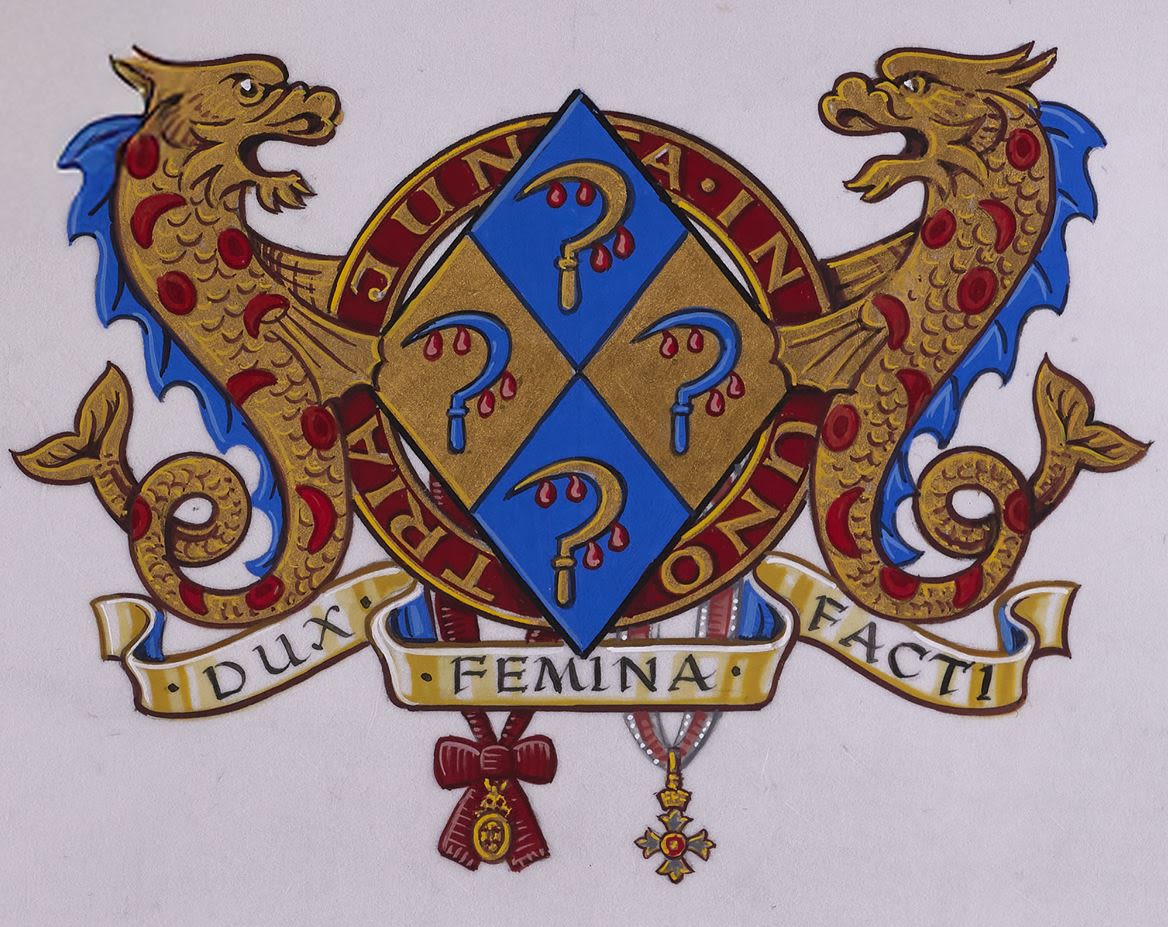
The coat of arms of Dame Sally Davies.
The coat of arms of Dame Sally Davies.
The process of granting arms began with a trip to the College of Arms to discuss the design with Timothy Duke, lately Clarenceux King of Arms. The rank of GCB allows many opportunities to introduce references to different aspects of the public life of the grantee, as Knights and Dames of this rank are required to have not only a shield but also supporters flanking it, and a motto. To represent Dame Sally’s pioneering medical research on sickle cell disease, an arresting design of sickles dripping with blood was proposed. In place of a knightly shield, Dames bear their arms on a lozenge, a format which can rather elegantly be divided into four smaller lozenges. The rich heraldic vocabulary which mainly derives from Norman French uses the word ‘embrued’ to convey ‘dripping with blood’, and this results in a blazon of Per saltire Azure and Or four Sickles counterchanged embrued proper.

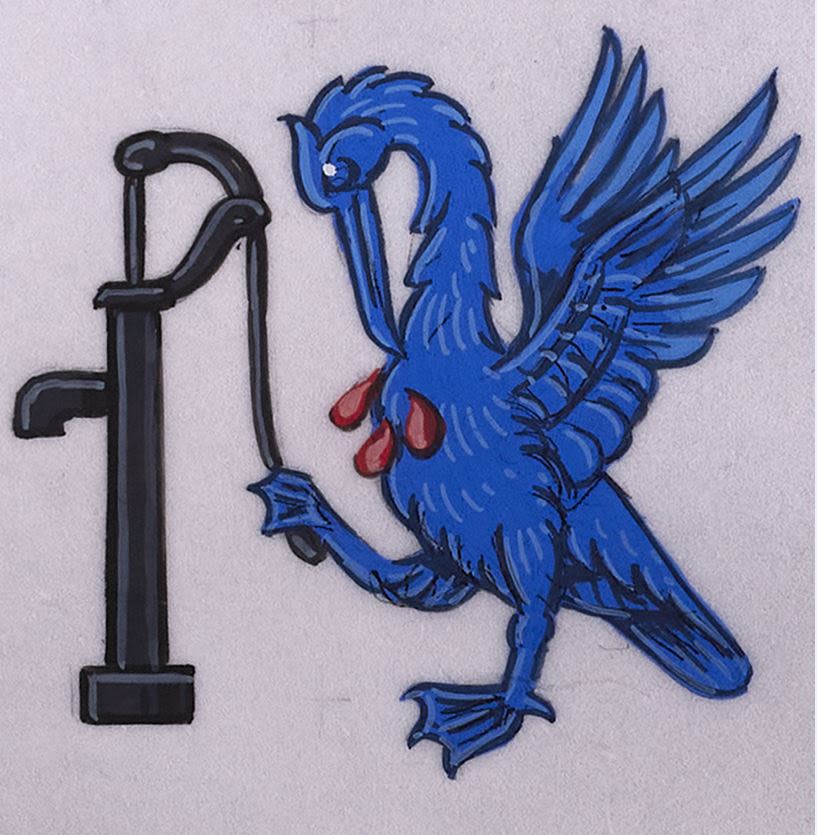
The badge: ‘A Pelican Azure vulning itself proper resting the dexter foot on the handle of an Iron Water Pump Sable’.
The badge: ‘A Pelican Azure vulning itself proper resting the dexter foot on the handle of an Iron Water Pump Sable’.
The lozenge is supported by two dolphins, creatures that have always been close to Dame Sally’s heart. These are no ordinary dolphins, since heralds of past centuries assumed that dolphins were ferocious beasts of the sea, so they are depicted with fierce jaws and bright blue manes, strewn with a mixture of standard red blood cells and sickle red blood cells.
The arms are surrounded by a circlet bearing the motto of the Order of the Bath, the appropriately Trinitarian phrase Tria iuncta in uno. But the grant of arms also includes a motto particular to the awardee. At this point the Classics Fellows were consulted on a suitable Latin motto to refer to Dame Sally’s position as the first woman to be appointed Chief Medical Officer, first female Master of Trinity, and first non-royal Dame GCB. It came as something of a surprise to find that the memorable phrase which introduces Dido of Carthage in Book I of Virgil’s Aeneid, ‘Dux femina facti’, has never previously been used as an heraldic motto. Its succinct form is difficult to render in English, but perhaps the most elegant translation is John Dryden’s: ‘A woman was the leader of the deed’.

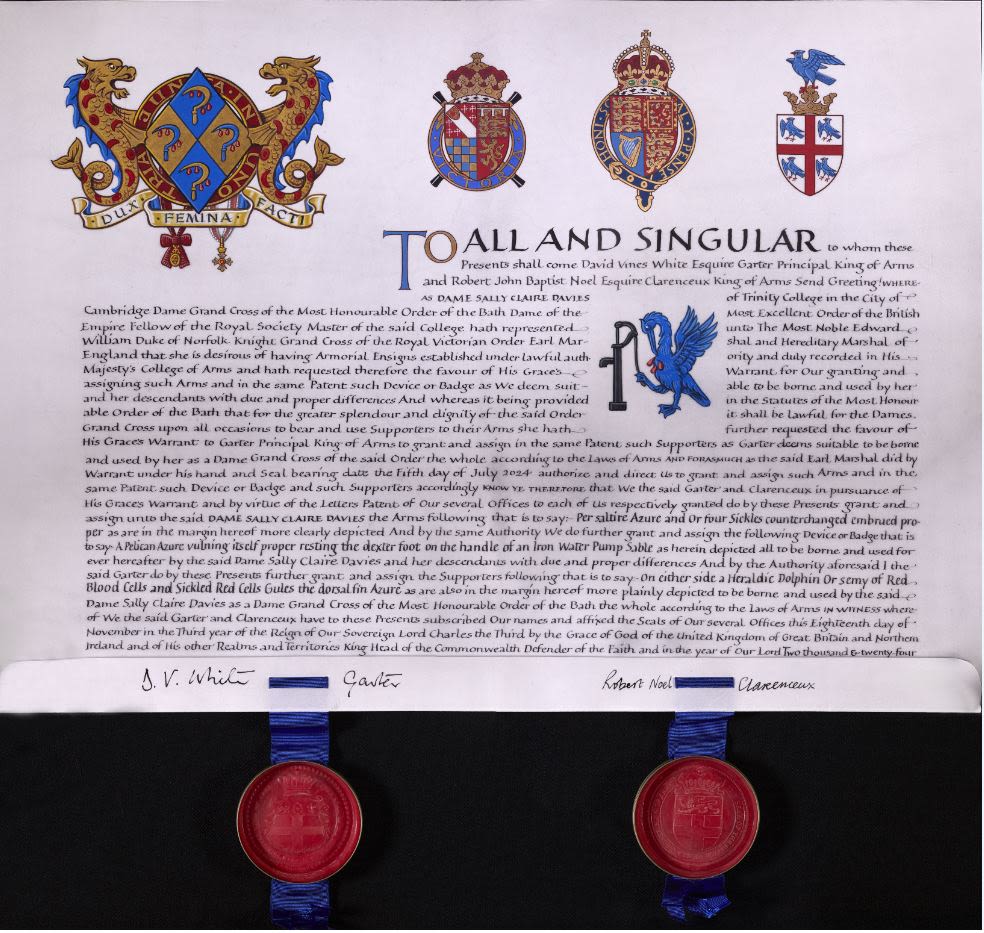
The coat of arms of Dame Sally Davies.
The coat of arms of Dame Sally Davies.
In the Bath Chapel, Knights normally have their helms and crests displayed above their stalls. It is not the custom for Dames to wear helmets, and so an alternative was proposed for Dame Sally in the form of an heraldic badge, which will in due course be sculpted to surmount her stall. The badge consists The grant of arms, with the seals of the Garter and Clarenceux Kings of Arms. Since medieval times the pelican has been associated with blood transfusion, as legend spoke of the mother pelican wounding herself in order to feed her young with her own blood. This pelican has the bright blue colour of the global Antimicrobial Resistance campaign, a reference to Dame Sally’s appointment as the UK Special Envoy on Antimicrobial Resistance. The water-pump is the pump identified by Dr John Snow as the source of the 1854 cholera outbreak in London, and stands for the containment of epidemics, a reference to Dame Sally’s epidemiological work while Chief Medical Officer.
At the time when the Garter King of Arms granted the Master’s coat of arms at the end of 2024, the Dining Hall was covered in scaffolding and the heraldic windows were undergoing the most extensive renovation in their history. The College Council therefore saw the opportunity to fill one of the blank panes in the West Oriel window with a new stained glass window depicting the Master’s newly granted arms. Stained glass artists who specialise in heraldry are unsurprisingly few and far between, but the College was delighted to establish connection with Petri Anderson of Mongoose Stained Glass, whose previous clients had included the late Queen and Prince Philip.

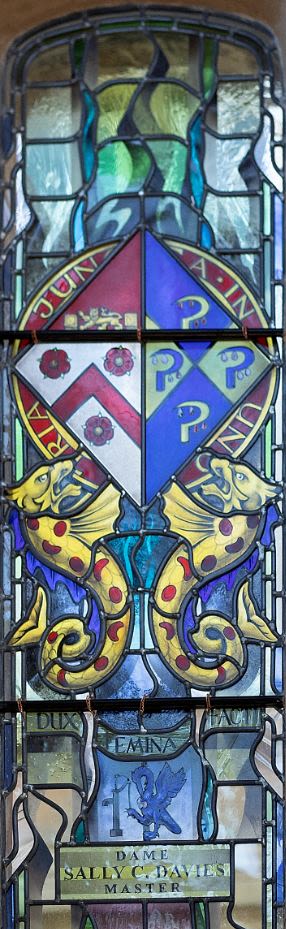
The new window in the Hall.
The new window in the Hall.
While serving as Master, Dame Sally is entitled to impale her arms with those of the College. This makes for a rather more crowded design, as the bold pattern of four sickles has to compete with the familiar lion and Tudor roses. But the design of this window manages very successfully to bring a contemporary style through its use of organic fluid background patterns, while not looking out of place adjacent to its more historic neighbours. It continues a tradition that has been ongoing since the construction of the Hall in 1604, and provides a fitting tribute to the first Dame Grand Cross to be a member of the College.

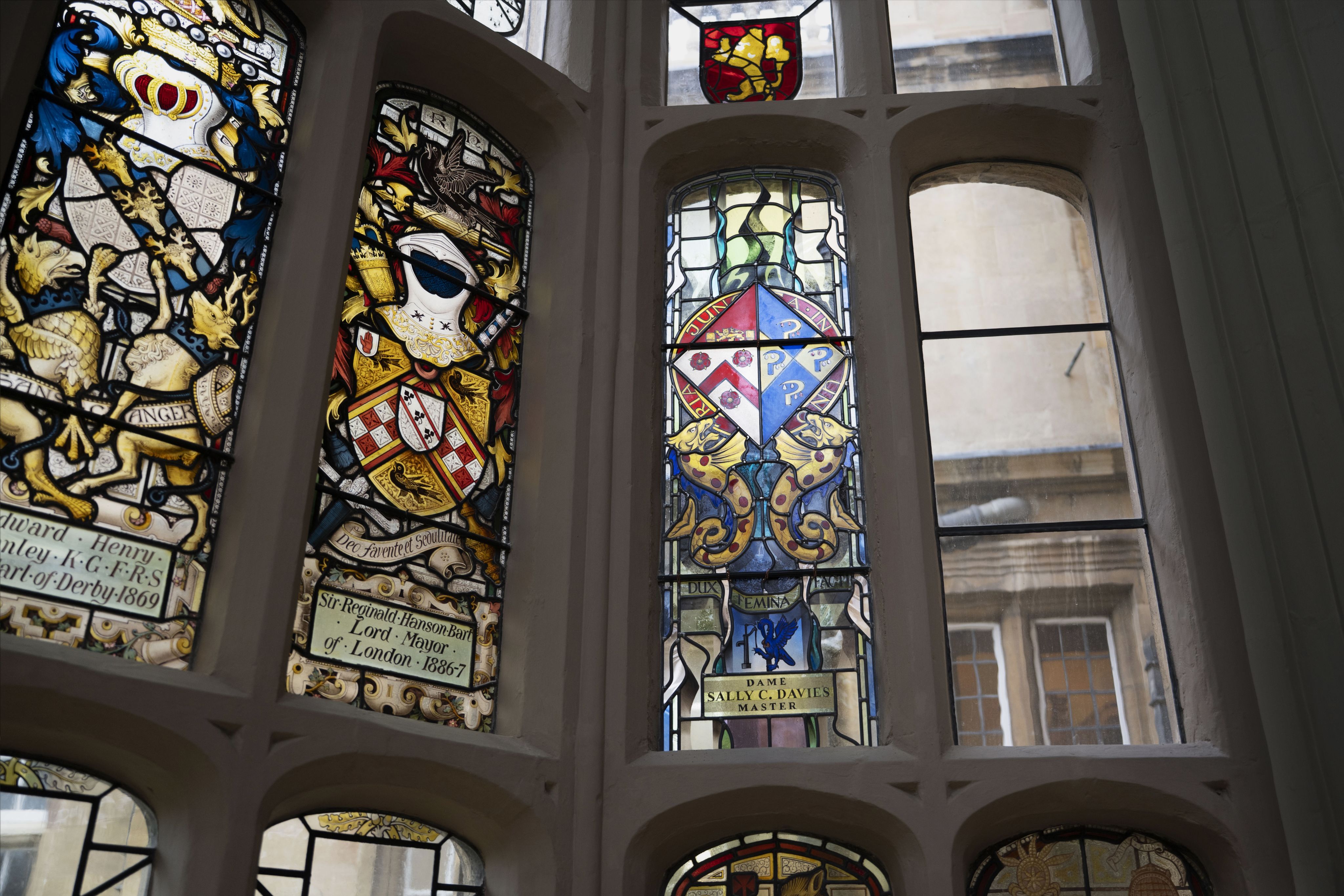
The new window (right) with its neighbouring designs.
The new window (right) with its neighbouring designs.
This article is included in the latest edition of the Annual Record.

 Built with Shorthand