
A Brief History of the Trinity Boat Clubs, 1825-2025
by Luke Barratt (2018)
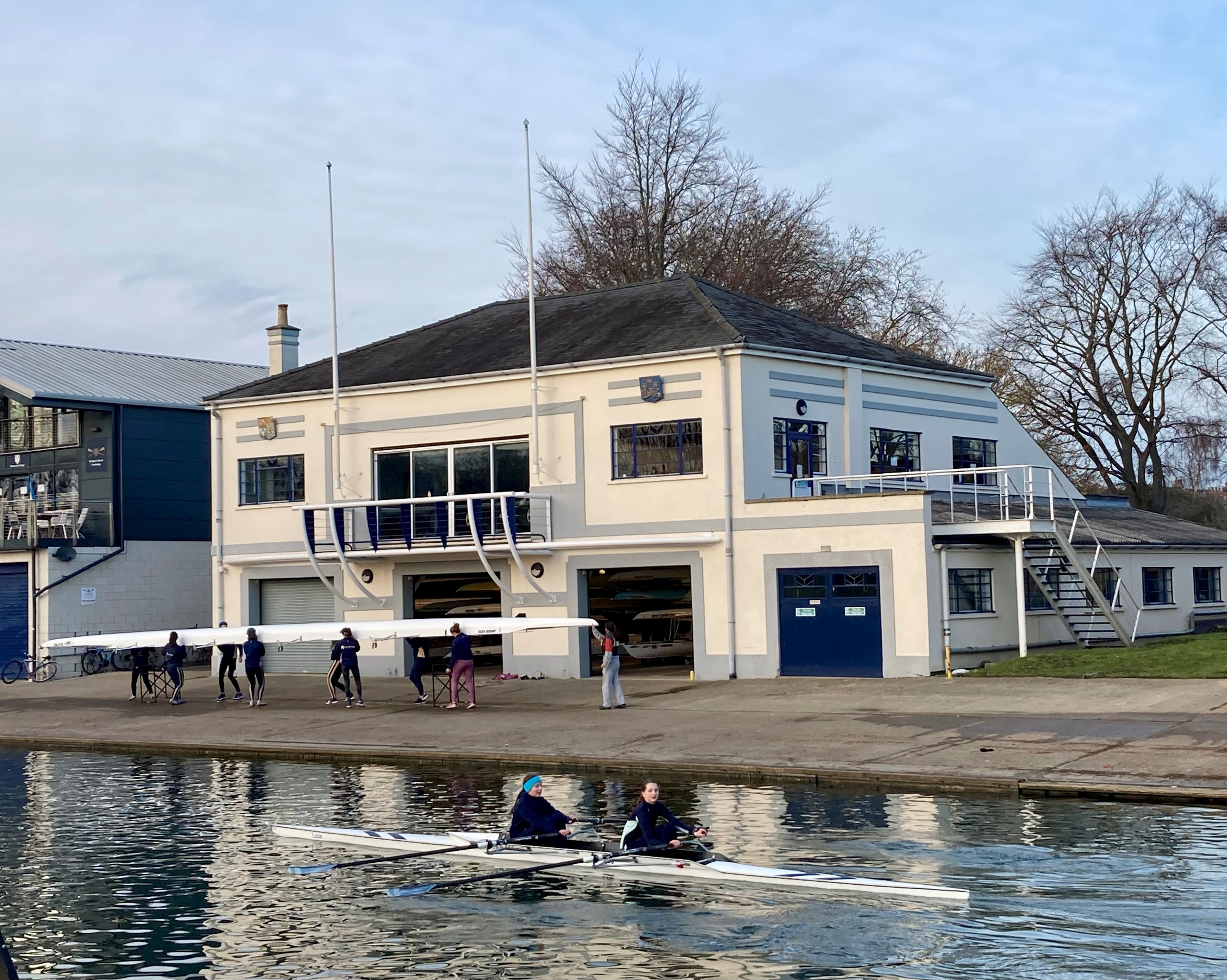

Sum pius Aeneas, raptos qui ex hoste Peates
classe veho mecum, fama super aethera notus.
(Virgil, Aeneid, 1.378–9)
A Prologue
As our motto reads: fama super aethera notus – so claims Aeneas of himself, invoking his loyalty to gods and family in a bid to win the favour of a goddess he does not yet recognise as his mother, Venus. He is stranded on the coast of Africa, his men scattered, and yet it is he who will father the Romans, a people to whom Jupiter did promise: imperium sine fine dedi.
How apt, then, that this same wanderer, between trials, organises a boat race in Sicilian waters on the anniversary of his father’s death. Not grief, but the pursuit of glory, as four galleys of men strain, watching the sign to start:
Then, at the trumpet’s piercing sound, All from their barriers onward bound: Upsoars to heaven the oarsman’s shout: The upturned billows froth and spout.
Virgil’s account swells with violence and ambition. A ship wrecks. Oars shatter. One helmsman is thrown overboard. Victory goes to Cloanthus of the Scylla, not by strength and wit alone, but by prayer – as the hidden hand of Portunus carries his crew to triumph, and Aeneas proclaims the result.
The centuries roll on; the oar remains. In the wake of another great European war of land and sea, a nameless boy enters Westminster School. It is 1815. Napoleon is defeated. The navy is diminished. Now the Thames is newly cluttered with gigs and cutters, in the height of post-war naval enthusiasm. Boating thrives, and the eight-oar begins to dominate the tidal waters. Glory in battle now turns to sport. Bell’s Life in August 1824 reads:
Never was there a time when so many pleasure-boats were to be seen upon the river. This circumstance has led to frequent wagers, and those wagers have increased the number of vessels calculated to contend for the various prizes.
This boy, watching from Westminster, matures. In time – now man – he comes up to Trinity College, bringing the Thames with him. J. J. Smith’s Cambridge Portfolio records him with reverence, noting his rare gift to ‘so far abstract his mind as to invest the waters of the Cam with the qualities and capabilities of the mighty Thames’. And so, from a tradition of slow voyages to Ditton in canoes and funnies, there rises a new form of rowing on the Cam.
It is this history I attempt to tell – from the makeshift fours of 1825 to the bicentenary of their successors in 2025. To recount it in brief is to fail its richness; but the thread of contest, glory, loss, and camaraderie is unbroken, and runs still in our time.

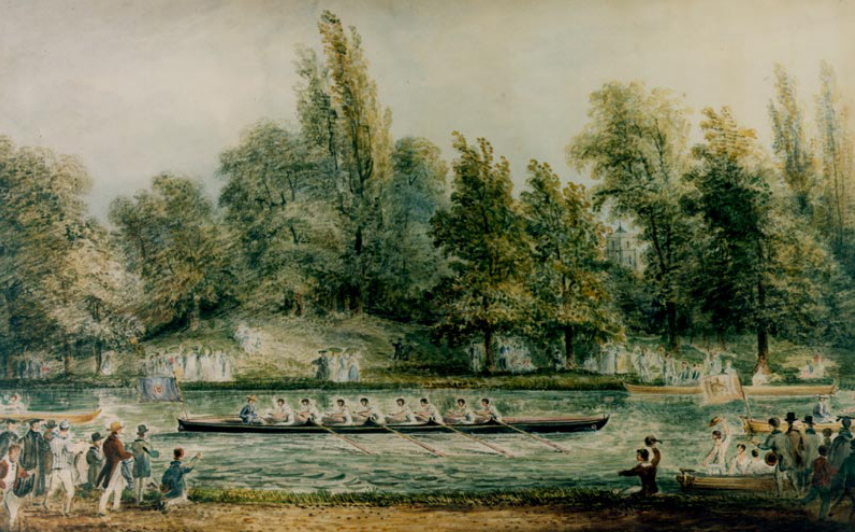
An early depiction of racing, centred on a First Trinity crew in a shell painted black.
An early depiction of racing, centred on a First Trinity crew in a shell painted black.
The Early Clubs
The first strokes of Trinity rowing are half-veiled in mist, glimpsed only through memory and fragmentary record. Yet one truth is certain: by the spring of 1825, a recognisable Trinity boat club was afloat – the oldest at Cambridge.
Much of what we know rests on the recollection of C.F.R. Baylay, who, writing in The Field in January 1882, casts his mind back more than half a century:
In the spring of 1825, four Trinity men, of whom I was one, used very frequently to hire a four-oar when we felt inclined for a row. Sometimes, finding the boat we liked best engaged, we formed ourselves into a club, and hired a four-oar called the Shannon by the term. This was the first Cambridge Boat Club.
So it began: not with statutes or committees, but with four young men and a hired boat. Yet their example was quickly answered. From the following October, Johnians launched their own eight-oar, christened the Lady Margaret – the first of its kind upon the Cam. Trinity could not stand idle. The Shannon men purchased an eight-oar named the King Edward to rival her. Soon after, further craft appeared upon the water: the ten-oared Monarch and the six-oared Westminster, both of Trinity. In 1827, these three Trinity clubs, alongside boats of other colleges, contested the first organised bumps races.
The contest was fierce, the survival uneven. The Westminster vanished almost at once; the Monarch laid aside its ten-oar and embraced the eight. By the year’s end, two Trinity eights – the King Edward and the Monarch – remained, and by early 1828 they had merged as a single Trinity Boat Club. Yet unity was short-lived. A second crew broke away, starting afresh at the bottom of the charts in 1829 under the name Second Trinity, the only Trinity crew to begin the 1829 bumps with First Trinity rejoining two races later. In the Mays returning as the Privateer, Second Trinity rowed until 1830. In 1831, a further Trinity crew arose – the Nautilus, later called Queen Bess. Its separate minutes and accounts mark it as more than a subsidiary crew: the true beginning of what endured as the Second Trinity Boat Club, broken up in 1838 but returning in 1840 and still active until 1876 (with a short revival in 1894–95 owing to political disputes).
Meanwhile, in October 1832, another fraternity took shape. Old Westminsters and Etonians, long accustomed to rivalry at school, combined their strength as the Third Trinity Boat Club. Their first years were inauspicious – a six-oar, middling results – until, in 1834, they turned to the eight. Then came glory. In nine races they rose eight places to seize the Headship. That year’s charts closed with Third first, First second, and Second third – the river crowned by Trinity alone.
By now the three clubs of Trinity were firmly established, each with its own colours and its own pride. Yet they were not always divided. In 1839, when the first Henley Regatta was called, Trinity sent not one club but all three together. Rowing as a single crew in the Black Prince, they won the Grand Challenge Cup, the prow of their victorious boat preserved to this day – a relic of unity, and of triumph. The First Trinity minutes record the Final Grand Heat between Trinity and the Etonian Club (Oxford), around 7 o’clock on Friday 14 June:
At starting the Etonian boat drew a little ahead, which advantage they continued to keep for about a quarter of a mile, when the T.B.C. recovered their lost ground. The 2 boats continued oar and oar till within a quarter of a mile of the end, when the T.B.C. drew a little ahead, & finally were declared the victors by exactly a boat length.
Rivalry and Revelry
With the spread of rowing in the 1830s and 1840s, the Cam became crowded not only with eight-oars in the Lent and May races, but with contests of every kind. Smaller boats – fours, pairs and singles – all had their place. At first these races were run as bumping contests, the losers struck out, the order redrawn afresh each day until only two or three remained, their quarrel settled by a timed trial. Soon formal competitions arose: the Colquhoun Sculls of 1837, the Magdalene Pairs of 1844, the University Fours of 1849. By the late nineteenth century, the old bumping format had given way to the familiar chasing races, and the calendar swelled with yet more contests: Light and Coxed Clinker Fours, the Forster–Fairbairn Trial Pairs, the Lowe Double Sculls, the Bushe– Foxe Freshmen’s Sculls. The water was alive with rivalry. Yet nothing rivalled in prestige or spectacle the Lent and May Bumps, which from 1887 stood as entirely separate competitions – and remain so still.
Competition was not only between clubs, but within. Each of the Trinity clubs fostered its own private rivalries. Among others, First Trinity offered the Macnaghten Sculls and Wyatt Pairs; Second Trinity the Baines Cup and Dodington Pairs; Third Trinity the Chambers Sculls and Pair Oars. These flourished until the Second World War, when such club races fell out of fashion. Only the Baines Cup endured, reborn at the request of CUBC as the Second Trinity Challenge Sculls – an inter-club competition that, much expanded, survives to the present as the only club-run small boats event.
But rivalry was only half the story. From the very beginning, racing gave way to revelry. In May 1838, the first Mays Supper was held at the Hoop Inn. The record speaks for itself:
Members of the Club and their Friends sat down, 38 in number, Mr Massey in the chair. 47 Bottles Champagne, 12 Sherry, 6 Moselle, 2 Claret, 6 Quarts of Ale and £6/14/– worth of Punch &c. were demolished on the occasion.
The revels, however, were cut short: ‘The proceedings of the evening were interrupted at an early hour, by the unexpected attendance of Mr Evans of St John’s, the Junior Proctor, who succeeded in breaking up the party.’
Almost thirty years later, in March 1866, celebration reached new heights. First Trinity hosted the first May Ball at the Red Lion Hotel. Some three hundred guests attended, and the Secretary noted with satisfaction:
It was a grand success – the only single drawback being the room which was too small for such a large and brilliant assembly. Ladies numerous, Julien’s band. A handsome supper. What more could be wanted?
What began at the Hoop Inn with bottles and punch became, in time, one of the most famous traditions of Cambridge life. The May Ball, though under the banner of First and Third Trinity Boat Clubs from 1897, and dropping the plural inflection from 1946, endures as a central element of student life still.
Through all these years of rivalry and revelry, camaraderie was never absent. Songs, poems and verses echoed across the boathouses. R.C. Lehmann, in his A Trinity Boating Song, caught the spirit best:
Then shout for old First Trinity, and let your song be heard
Not less for those who proudly wear the blue and white of Third.
One kindly mother claims us all, she bids us play our parts
As men whose Clubs are separate, while friendship joins their hearts.
We ply the oar in rivalry, and in the mimic fray
With eager zest and dogged pluck we battle through the day.
But when the gallant fight is o’er, united we can stand,
And hold our own in name and fame, but clasp a foeman’s hand.
The words still ring true. Rivalry on the river; revelry on the bank – some descriptions of which are perhaps best kept in the Boat Clubs’ archives. But at the heart of all this persists a single comradely tradition, shared.

Floreat Prima, Floreat Tertia
The year 1849 found Trinity men at the forefront of Cambridge rowing. That spring, the Light Blue eight was composed entirely of Trinity oarsmen – men of First, Second and Third alike. It was Trinity against Oxford, and victory was emphatic: the Light Blues came home a full minute clear. Indeed, the history of the Boat Race is awash with Trinity men. Not a single contest from the inaugural race of 1829 until the wartime merger was without a Trinity man aboard, and more often than not there were several. By the eve of the Second World War, two in every five Light Blues had been from Trinity.
This dominance – in particular of First and Third – was not confined to the Thames. On the Cam, the Bumps charts stand as testimony to Trinity’s long mastery. Before the Lents and Mays were divided in 1887, Trinity crews were Head of the River in more than half the years. Thereafter, until the outbreak of the Second World War, they claimed the Lents Headship almost a third of the time, and the Mays Headship nearly as often – some thirty-eight per cent of all Headships in that long century of racing.
Nor was Henley spared. From the triumph of the Black Prince in 1839, Trinity colours became a familiar sight upon the regatta course. One century later, the tally of victories stood at eighty-one, a roll-call unmatched by any other club. The old song of C. Q. Knowles rang true:
At Henley e’er since the days of Black Prince,
her vict’ries have been not a few.
And full often I ween have her colours been seen
triumphant on home waters too.
Of the river she’s often been head,
And the pathways of honour to tread:
Her members full oft the dark blue have doff’d and adopted the light blue instead!
Nor was Trinity’s reach confined to English waters. In July 1876, a Trinity crew crossed the Atlantic to Philadelphia, only for their prospects to be undone by an untimely bout of malaria in their Captain. Yet most resplendent of all were the Olympic Regattas of the interwar years. In Paris, 1924, the gold medal in the coxless four went to a crew of Third Trinity; four years later in Amsterdam, First Trinity repeated the feat. Thus, within the space of two Olympiads, both of Trinity’s clubs had carried Britain to glory – triumphs that crowned a century of supremacy.

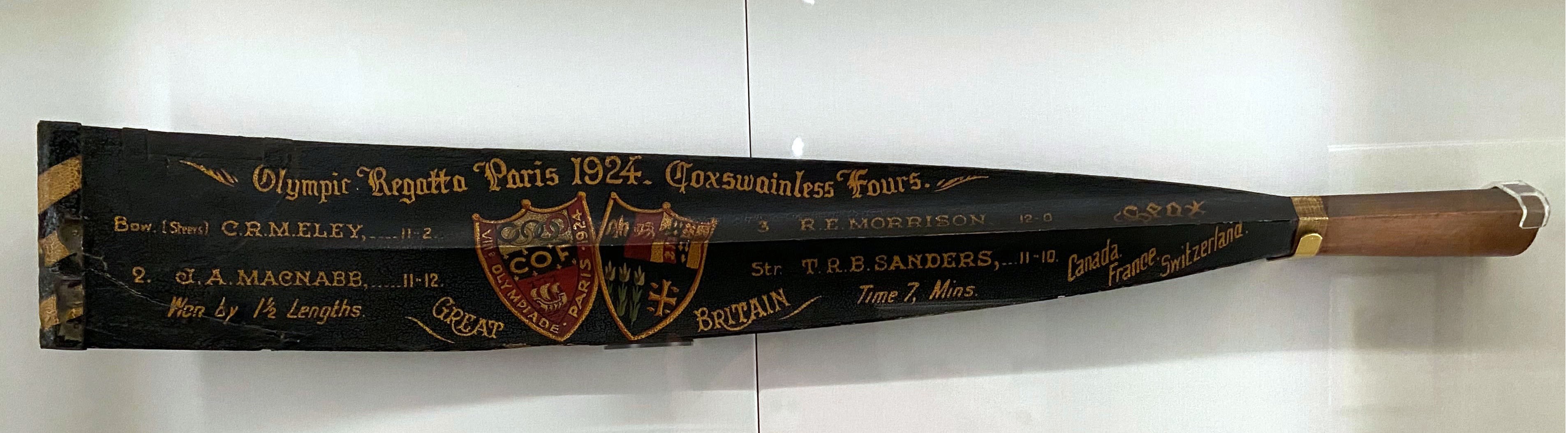
The presentation oar of the 1924 Olympic crew.
The presentation oar of the 1924 Olympic crew.
War and Recovery
The outbreak of war in 1914 brought Cambridge rowing abruptly to a standstill. Trinity’s boathouses emptied as oarsmen volunteered in great numbers. In October that year, W.W. Rouse Ball chaired a meeting of First Trinity, at which it was reported that the Captain, Secretary and Sub-Treasurer of the previous year, together with those newly elected, were all absent on military service. Racing was abandoned, and the boathouses themselves were requisitioned by the army. More than a hundred Trinity oarsmen lost their lives. The presentation oar of the 1924 Olympic crew.
When peace was restored, revival came haltingly. The First Trinity boathouse had suffered damage, and in Michaelmas 1918 the minutes record that only fixed-seat rowing was attempted, ‘owing to lack of a coach’. The influenza pandemic of 1919 claimed more young lives still, and it was some years before rowing on the Cam resumed its former vigour.
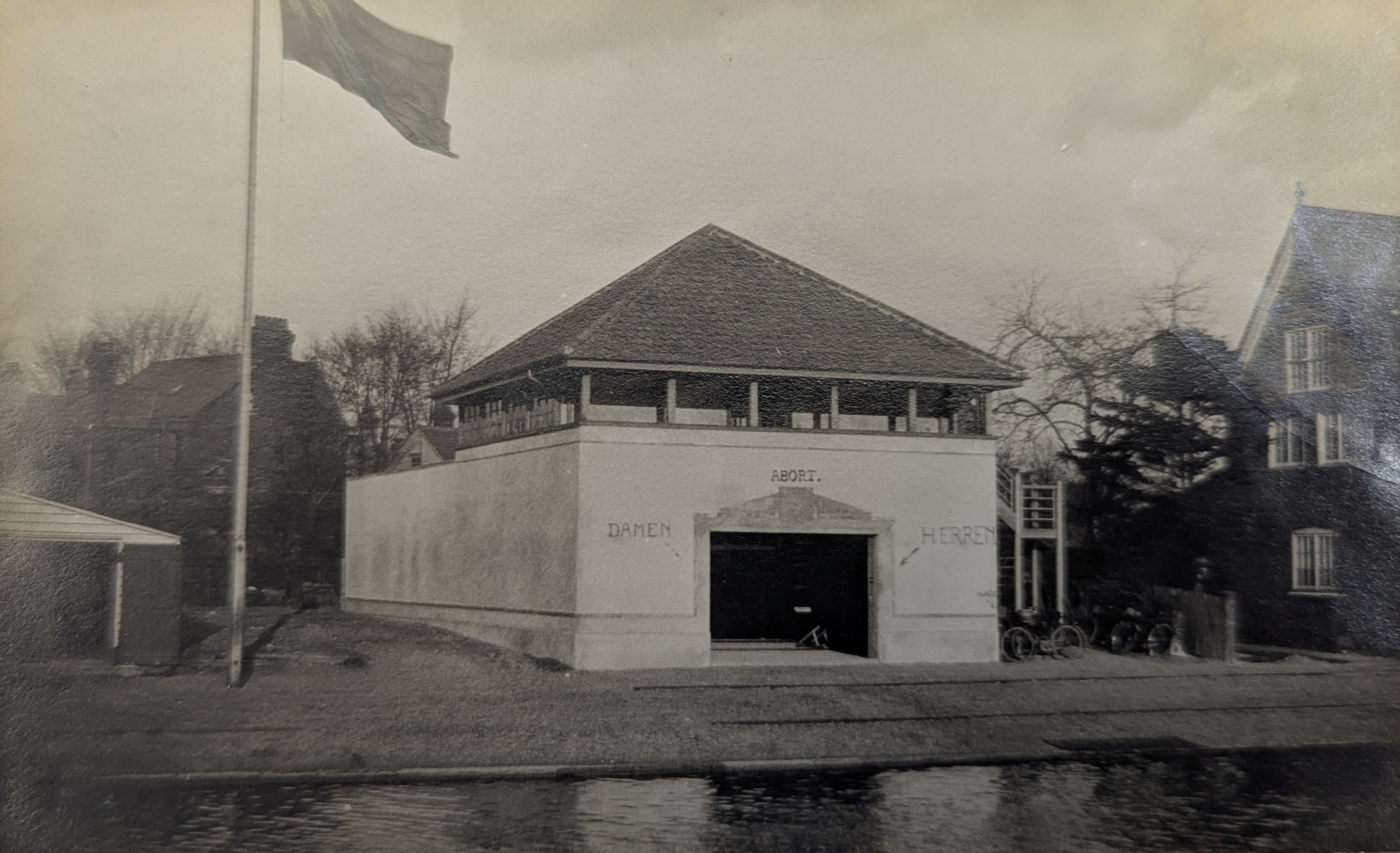
The work of restoration was not only that of undergraduates. Alumni of both clubs returned to coach or contributed funds to shore up fragile resources. In 1930, Third Trinity issued an appeal to its bufties, declaring their accommodation ‘in imminent danger of collapse’. The response was generous: money was raised to build a new boathouse on First Trinity land, which later passed to St Catharine’s. First likewise undertook substantial renovation in the 1930s, their appeal again met by the loyalty of old members.
On the water, both clubs found renewed, if uneven, success. With the infusion of promising schoolboy oarsmen, Third performed well in the University Fours and in the Mays, while First were frequently found at the Head of the Lents. Yet, by the 1930s, the signs of change were unmistakable. As schoolboy rowing waned in importance on the Cam, so too did the small-boat racing that had once sustained the internal life of the clubs. New events, such as the Fairbairn Cup and Head of the River Race, drew the focus to the eight, and the old Trinity duopoly began to loosen its grip.
In 1939, as war once more closed over Europe, the river altered again. The proud, if patchy, resurgence of the interwar years had brought moments of distinction, but darker contests now commanded the energies of a generation. A few crews still rowed, cutting the last golden wakes through the Cam’s summer waters, yet many again would not return. Trinity men enlisted in their hundreds; Third, in particular, found it ever harder to put out competitive boats. Wartime necessity eroded the fierce independence of the two clubs.
At the close of his Captaincy in June 1940, R.W. Hogg of Third set down a final entry into the minutes:
I am glad to say that Third has survived one year of war, but it is with deep regret that we learn the news that P.F. Hamburg, last year’s captain, is reported missing in Flanders. I am afraid there will be more news of this nature before the war is over. Meanwhile, all the best for Third in the future, and may my successor enjoy writing up this leaflet, especially when he gets near the bottom of a page and finds no support for his hand. A familiar and, I hope, intelligible sentence to end this inscription is: ‘Floreat Tertia’.
The following page, penned by I.R. Clout in Michaelmas 1940 recorded the steep decline in membership and acknowledged the inevitable:
I hope the amalgamation of 1st & 3rd will be a permanent & a successful one, as, in the face of tradition, I must consider that the independence of Third has outlived its usefulness. Floreat Prima et Tertia.


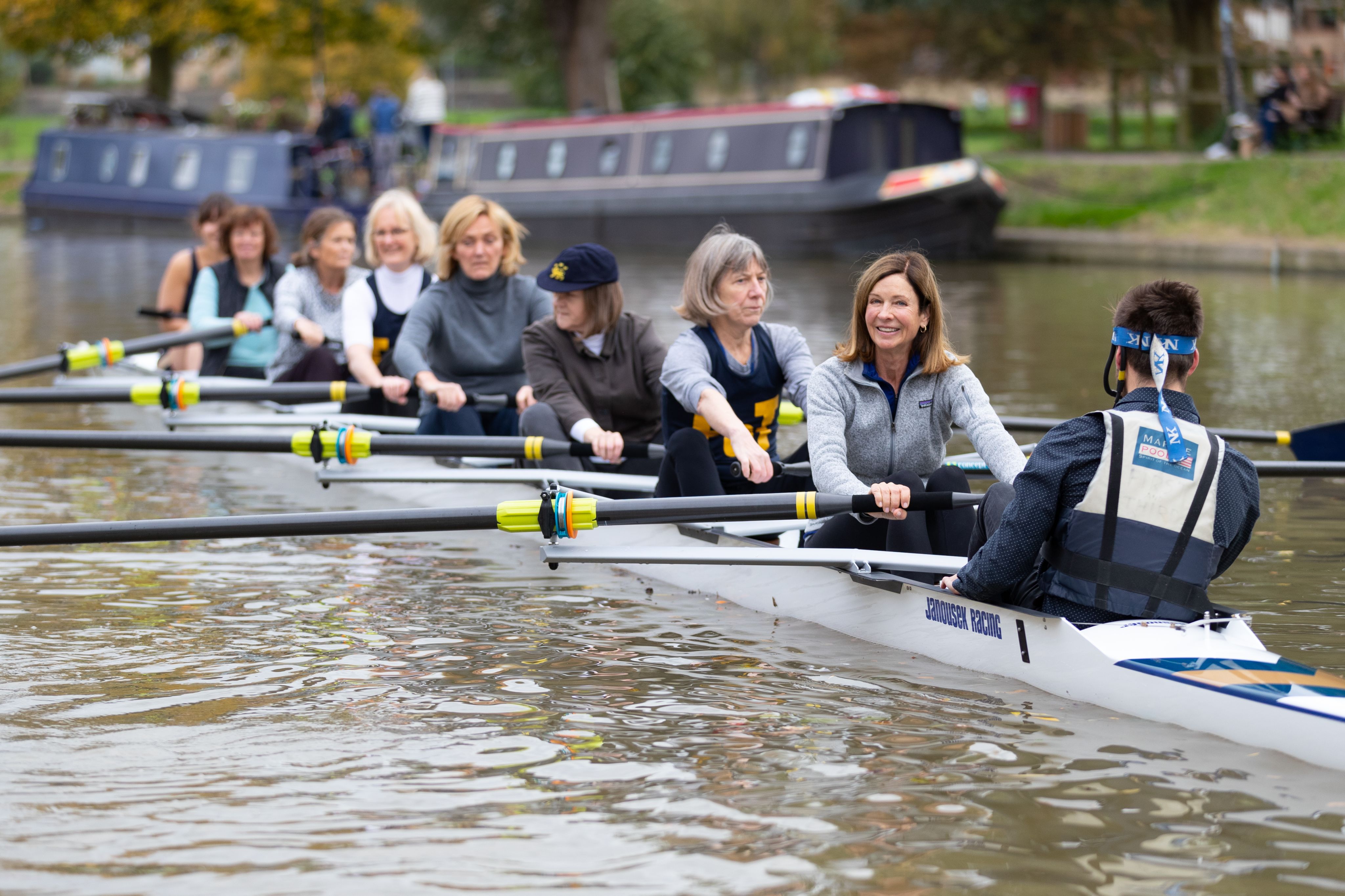
A North (stroke) and members of the first women’s crew rowing the new women’s eight, Amanda, 2021. © David Johnson Photography.
A North (stroke) and members of the first women’s crew rowing the new women’s eight, Amanda, 2021. © David Johnson Photography.
A Whole New World
This amalgamation of 1941 bore fruit at once. In the June Eights of 1945 – the wartime substitute for the May Bumps – First and Third together claimed Headship, the first Trinity crew to do so since 1929. What had begun as a union of necessity was, by 1946, confirmed in perpetuity. Rivals for more than a century, First and Third were now one.
Three decades later, fresh change reshaped the club. In 1978 the first women undergraduates were admitted to Trinity, and before long a band of pioneers, as their male forebears had done in the 1820s, formed themselves into a boat club under the captaincy of Amanda North, who later recounted:
But then I spotted a particularly lively (and fit) group of men. I sidled up to them to investigate – it was the Men’s First & Third Boat Club. Intrigued, I innocently inquired about a ladies’ team. They laughed and told me there was no such thing. Undaunted, I blurted out ‘could I start one?’ Laughing again, they said – sure, why not...
Their early years were marked by difficulty: rowing in hand-me-down men’s shells, with oars poorly suited to their strength, they faced disadvantages against women’s clubs better equipped. The President, Denys Lawrence, wrote in a letter to the College Council at the time:
Last Mays we witnessed the sad spectacle of four very small Trinity Ladies struggling along in a boat so large that it was floating right out of the water, and using the same size oars as are used by the East German Olympic Eight. This is NOT a good advertisement for Trinty either as a charitable foundation or as a centre of intellectual excellence.
Yet with the support of donors and alumni, their first purpose-built boat – a shell christened Margot – was launched in 1990, a visible sign that women’s rowing at Trinity had come of age.
The world beyond the Cam was altering too. In 1991 the World Wide Web was unveiled by Tim Berners-Lee, and Trinity oarsmen were quick to see its possibilities. From modest beginnings, the Boat Club website grew in a vast and admired enterprise. In Cambridge it soon outpaced official channels as the most reliable source of results and news. Its BumpIT prediction game became a favourite diversion for rowers across the University, while its archives of race crews, reports, and photographs have built an unparalleled record of the last quarter-century – a digital chronicle no less rich than the old minute books. Constantly renewed and expanded, it now aims to embrace the whole history of Cambridge rowing since the 1820s.
Not every new world has been benign. In 2020 the Covid-19 pandemic once more stilled the Cam. The Bumps were cancelled, boathouses fell silent, and Zoom circuits replaced outings. Even when rowing resumed, it was restricted to fours, and a generation’s worth of experience was lost. Recovery has been gradual: some traditions were revived, while some have lapsed, and new ones have found their place. Yet through it all the spirit of Trinity rowing endures, as resilient in the twenty-first century as it was in the nineteenth.
Floreat Prima et Tertia
Since the union of the 1940s, First & Third Trinity has written fresh chapters of success. The first post-war Henley Royal saw the newly amalgamated club claiming its first Henley victory, taking the Visitors’ Challenge Cup. The following summer, they added the Ladies’ Plate, a trophy won again in 1954 and 1967. Though the balance of Henley has shifted since, with college crews no longer the dominant force they once were, First & Third has continued to hold its own with distinction amongst its peers.
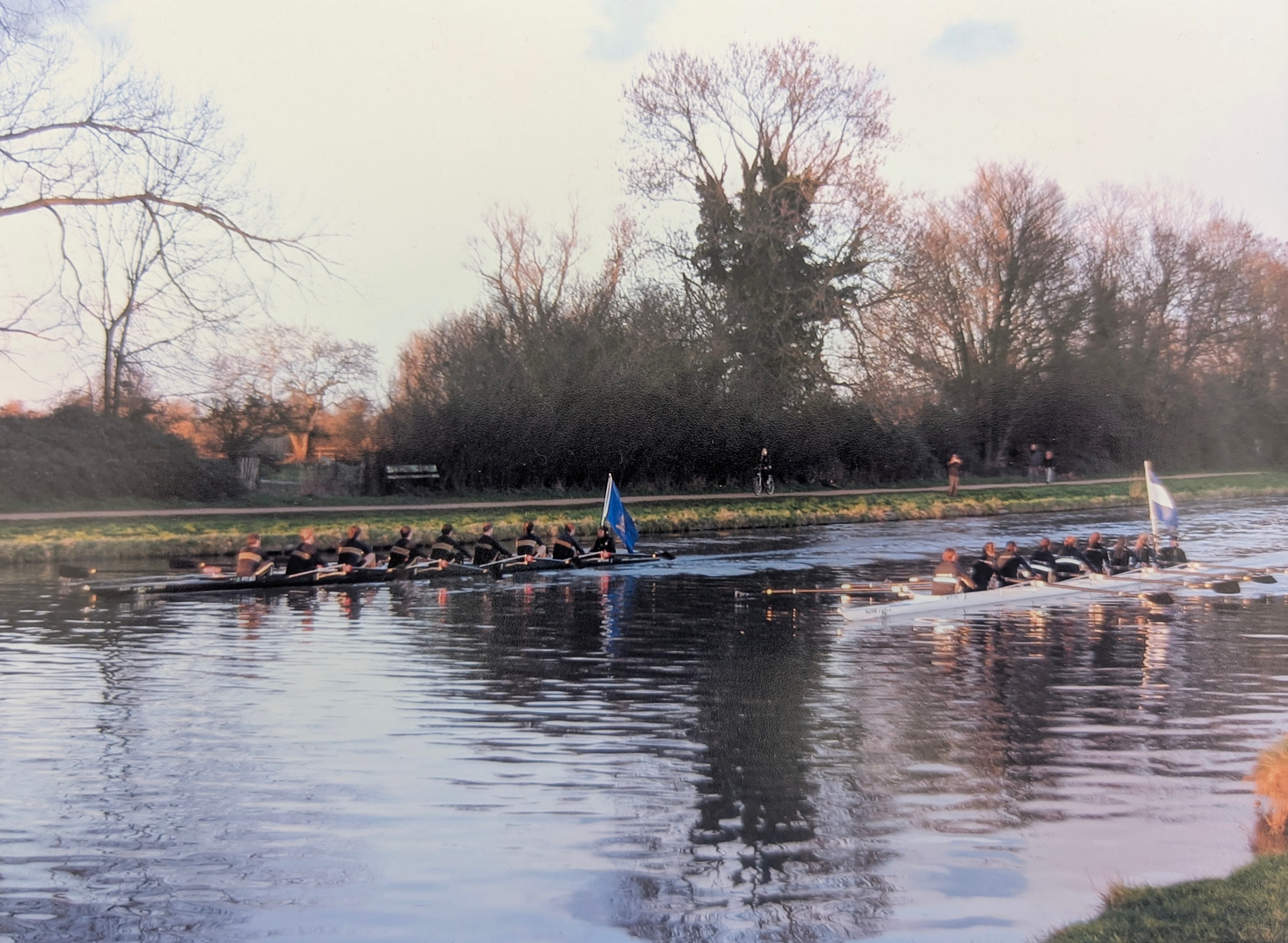
The admission of women to Trinity brought with it a new possibility: the Double Headship. For years it remained only an aspiration. But in 2007, after long labour, the dream was realised: in the Lent Bumps both men and women rose to Head of the River. For a shining moment, the Cam belonged entirely to First & Third. The feat was maintained in 2008 and repeated in 2010, while in those years the men also claimed the Mays Headship. The complete set of four – both Lents and both Mays together – remains still to be achieved, a prize to which the Club continues to aspire.
Nor has Trinity’s tradition of international triumph faded. A century after the Third Trinity coxless four seized Olympic gold in Paris, Imogen Grant – who first took up an oar at First & Third in 2014 – returned to the same waters to win gold in the lightweight double sculls. From Black Prince to the Double Headship, from Henley to the Olympic stage, the flame endures: Floreat Prima et Tertia.

An Epilogue
Two centuries have passed since four Trinity men first bent their backs in a hired four-oar, giving birth to what would become the oldest boat club at Cambridge. From the Shannon to the Black Prince, from Lady Margaret’s first rivalry to the unity of First and Third, the line has run unbroken: boats rising and falling, clubs dividing and rejoining, names painted and repainted in fading lists. Wars came, and wars passed. Some never returned; others rowed on. Yet always the Cam held its course, and Trinity its place upon it.
The bicentenary of 2025 is not only a moment of looking back, but of recognising endurance. The races won are many, the champions remembered, yet the greater triumph lies elsewhere – in the persistence of crews unknown, in mornings of frost and fog, in outings unmarked by victory but heavy with effort. A boat is both captained and crewed: glory may touch the few, but it is built stroke by stroke from the labour of the many.
So it was with Aeneas, weary yet unyielding, who in the midst of storm and loss commanded his men to race – not for idle sport, but to bind the living, to honour the dead, and to hold fast to the hope of renewal. His words persist across the millennia: durate, et uosmet rebus seruate secundis – endure, and preserve yourselves for happier days.
So too with Trinity rowing. Not empire, but endurance. Not conquest, but continuity. Two hundred years on, the blades still rise and fall on the Cam. The motto still holds: fama super aethera notus – fame carried above the sky. Not only in the blaze of victory, but in the steady, unbroken drive that has bound generation to generation, and will yet carry us forward.
‘Comrades and friends! for ours is strength
Has brooked the test of woes;
O worse-scarred hearts! these wounds at length The Gods will heal, like those.
You that have seen grim Scylla rave,
and heard her monsters yell,
Yon that have looked upon the cave
Where savage Cyclops dwell,
Come, cheer your souls, your fears forget;
This suffering will yield us yet
A pleasant tale to tell.
Through chance, through peril lies our way
To Latium, where the fates display
A mansion of abiding stay:
There Troy her fallen realm shall raise:
Bear up, and live for happier days.’
This article is included in the latest edition of the Annual Record.

 Built with Shorthand